


Key Child Development Milestones for Ages 3 to 5

Between ages 3 and 5, children change in ways that can feel sudden. A child who once used single words may start telling long stories. A cautious walker may begin climbing, hopping, and dancing. Play also becomes richer, with pretend kitchens, doctor games, block towers, and long negotiations over whose turn comes next.
Milestones are useful because they show the skills many children gain around a certain age. They are not a strict exam. A child may speak early but take longer with toilet training. Another may run confidently but feel shy in a new preschool classroom. What matters most is steady progress over time.
This guide covers the key areas to watch: movement, language, thinking, social skills, and everyday independence. It is informational only and does not replace advice from a paediatrician, developmental specialist, or qualified healthcare professional.
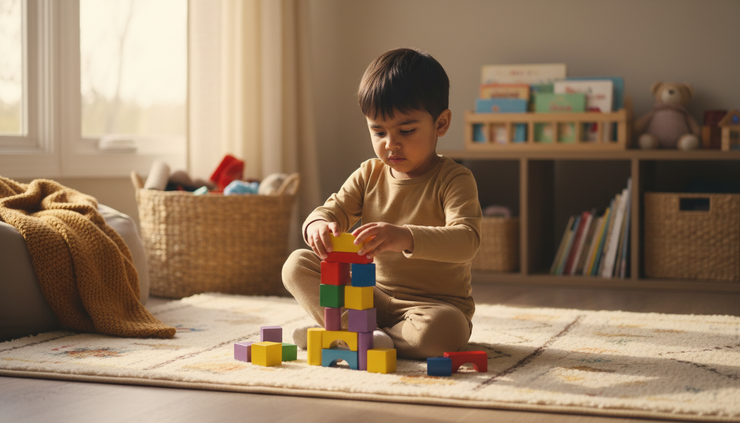
Why milestones matter between 3 and 5
The preschool years build the base for school readiness, friendships, communication, and self-care. Children at this age learn through movement, play, songs, stories, imitation, and repeated practice. They also learn by watching adults respond to frustration, sharing, waiting, and mistakes.
Milestones help families and educators notice whether a child is moving forward across different areas. They also help spot delays early. Early support can make daily life easier for the child and the family, especially when it begins before formal school pressure starts.
A useful way to look at development is by domain:
Area of development | What it includes |
Physical and motor skills | Running, jumping, balancing, drawing, using fingers and hands |
Language and communication | Speaking, listening, asking questions, following instructions |
Cognitive development | Memory, problem-solving, pretend play, early counting and sorting |
Social and emotional growth | Sharing, turn-taking, handling feelings, playing with other children |
Self-help skills | Eating, dressing, toileting, washing hands, simple routines |
Age matters, but context matters too. A child growing up with two or more languages may mix words while learning. A child who has just started playschool may take time to settle. A child with limited chances for outdoor play may need more practice with climbing, balancing, and ball skills.
What many 3-year-olds can do
At 3, children often move from toddler-like exploration to more purposeful play. They still need close supervision, but they begin to show clearer ideas, preferences, and routines.
Movement and hand skills
Many 3-year-olds can run with fewer falls, climb on low play equipment, pedal a tricycle, and walk up stairs using alternating feet. They may jump with both feet and begin to catch a large ball when it is gently thrown.
Fine motor skills also improve. A 3-year-old may:
Hold a crayon with better control
Copy a circle
Turn book pages one at a time
Build a tower with several blocks
Use a spoon with less spilling
Begin using child-safe scissors with help
Messy play helps at this stage. Dough, water play, finger painting, threading large beads, and tearing paper all build hand strength.
Language and communication
By 3, many children speak in short sentences and can be understood by familiar adults most of the time. They may ask “what”, “where”, and “why” questions often. They may name familiar objects, describe simple actions, and follow two-step instructions such as “pick up the cup and put it on the table”.
Some children talk a lot at home but speak less outside. This can be part of temperament or adjustment. What helps is a calm, patient environment with no pressure to perform.
Helpful daily habit: read one short picture book each day. Ask simple open questions like, “What is the dog doing?” or “What do you think happens next?”
Thinking and play
A 3-year-old’s pretend play becomes more visible. A banana may become a phone. A cushion may become a bus. This kind of play is not random. It shows memory, imagination, and symbol use.
Many children at this age can sort objects by colour or shape, complete simple puzzles, and understand ideas like big and small. Counting may begin, though the order may not always be correct.
Social and emotional skills
Three-year-olds often want to play near or with other children, but sharing can still be hard. Waiting for a turn may lead to tears. They may have strong feelings and limited words to explain them.
Adults can support them by naming emotions: “You are upset because the toy is not available.” This gives children the language they need before they can handle feelings independently.

What many 4-year-olds can do
At 4, children often become more social, more verbal, and more curious about rules. They may enjoy stories, songs, pretend roles, and group games. They also begin to test limits in more complex ways.
Movement and coordination
Many 4-year-olds can hop on one foot for a short time, catch a bounced ball, climb more confidently, and run around obstacles. They may enjoy dancing, action songs, and simple races.
Fine motor control grows stronger too. A 4-year-old may draw a person with a few body parts, copy simple shapes, use scissors to cut along a line, and start dressing with less help. Buttons, zips, and shoelaces may still be difficult.
Outdoor play is valuable here. Running, balancing, throwing, catching, and climbing support coordination and confidence. In urban areas where open space may be limited, even a safe terrace, corridor activity, park visit, or indoor obstacle course can help.
Language and storytelling
By 4, many children speak in longer sentences and tell simple stories about what happened during the day. They may use words like “because”, “after”, and “then”. They often enjoy riddles, rhymes, songs, and repeating new phrases.
They can usually follow three-step instructions when calm and attentive. For example, “Put your shoes near the door, wash your hands, and come for dinner.”
This is also the age when children may ask endless questions. These questions are part of learning, not just attention-seeking. Short, honest answers work best.
Thinking and early learning
Four-year-olds often understand matching, sorting, and simple patterns. They may recognise some letters, numbers, colours, and shapes. They may count objects, though they might skip numbers or count the same item twice.
Academic worksheets are not necessary for healthy development at this age. Play-based learning is usually more meaningful. Matching socks, sorting vegetables, counting steps, comparing cup sizes, and naming sounds during a walk are all useful learning moments.
Friendships and feelings
At 4, children often play with others for longer periods. They may create shared pretend games, such as shopkeeper and customer, teacher and student, or doctor and patient. Rules matter more now, but children may change rules to suit themselves.
Big emotions remain common. A child may cry over a broken biscuit or become angry when a game ends. The goal is not to stop all frustration. The goal is to help them recover and try again.
Useful phrases include:
“You can be angry. You cannot hit.”
“Let us take three breaths and try again.”
“Tell me what you need.”
“It is hard to wait. I will help you.”
What many 5-year-olds can do
By 5, many children look more ready for school routines. They may sit for longer, follow group instructions, ask detailed questions, and manage some personal tasks. They still need play, rest, and emotional support.
Gross and fine motor skills
Many 5-year-olds can skip, hop, balance on one foot, throw and catch a ball with better control, and move with more rhythm. They may enjoy simple sports, dance, yoga poses for children, or playground games.
Fine motor skills become more precise. A 5-year-old may copy a triangle or other simple shapes, draw a person with more details, colour within lines some of the time, and write some letters in their name. Handwriting does not need to be perfect. Grip, posture, and interest matter more than neatness.
Language and listening
A 5-year-old can often speak clearly enough for most people to understand. They may tell stories with a beginning, middle, and end. They can answer questions about a story, explain simple rules, and use language to solve small conflicts.
Children at this age also learn social language. They begin to understand when to say sorry, how to ask to join a game, and how to explain a problem to an adult. These skills grow through practice and modelling.
Thinking, memory, and school readiness
School readiness is not just knowing letters and numbers. It includes attention, curiosity, self-control, communication, and the ability to separate from caregivers for a reasonable time.
Many 5-year-olds can:
Count a small group of objects with better accuracy
Recognise some letters and numbers
Understand yesterday, today, and tomorrow in simple ways
Follow classroom routines
Complete simple puzzles
Retell familiar stories
Understand basic safety rules
A child does not need formal tuition to build these skills. Daily routines provide many chances. Setting the table teaches counting. Storytime builds memory. Helping pack a school bag builds planning.

Everyday skills that grow across these years
Self-help skills are a major part of development from 3 to 5. They may look small, but they build confidence and independence.
Eating and mealtimes
Many children in this age group can feed themselves with a spoon and fingers, drink from a cup, and sit through short family meals. Appetite may vary from day to day. Growth, activity, illness, sleep, and mood can all affect how much a child eats.
A calm routine helps. Offer a mix of familiar foods and small portions of new foods. Pressure, force-feeding, or constant bargaining can make mealtimes stressful.
Toileting and hygiene
Some children are toilet trained by 3, while others take longer, especially at night. Night-time dryness often comes later than daytime control. Accidents can happen during illness, travel, stress, or big changes.
Handwashing, brushing teeth with help, wiping after toileting, and bathing routines need repeated teaching. Visual routines can help, such as a small picture chart near the wash area.
Dressing and daily routines
Between 3 and 5, children gradually learn to remove simple clothes, put on sandals, pull up trousers, zip a bag, and help choose weather-appropriate clothing. Some tasks need many attempts.
Give enough time when possible. A rushed morning often leads to adult takeover. A slower weekend routine can give the child space to practise.
When to seek advice
Children develop at different speeds, but some signs deserve attention. A single sign does not always mean a serious problem. Repeated concerns across settings, or a loss of skills the child once had, should be discussed with a professional.
Consider speaking with a paediatrician or a child development specialist if a child aged 3 to 5:
Does not speak in short phrases by around 3
Is very hard for familiar adults to understand after 3
Does not respond to name or common sounds
Avoids eye contact most of the time
Shows little interest in people or shared play
Does not use pretend play by around 4
Cannot follow simple instructions
Falls often or seems much weaker than peers
Has extreme difficulty with chewing, swallowing, or feeding
Loses speech, movement, social, or self-care skills
Has frequent intense meltdowns that are hard to recover from
Shows behaviour that causes repeated injury to self or others
Hearing and vision checks are often a good starting point when speech, attention, or learning concerns appear. A child who cannot hear clearly may seem distracted. A child who cannot see well may avoid books, puzzles, or drawing.
How adults can support development at home
The best support for preschool development is often simple, repeated, and warm. Children do not need expensive toys. They need safe spaces, responsive adults, real conversation, and time to play.
Talk through daily life
Describe what is happening during everyday tasks. “The dal is hot, so we will wait.” “We are folding the blue shirt.” “The bus is stopping near the gate.” This builds vocabulary naturally.
Pause and let the child reply. Conversation works better than constant instruction.
Read and tell stories
Books build language, attention, memory, and imagination. So do family stories, folk tales, and made-up bedtime stories. In multilingual homes, reading and storytelling in any comfortable language is useful. Strong language in one tongue can support learning in another.
Protect free play
Free play gives children a chance to make choices, solve problems, and practise social rules. Blocks, dolls, kitchen vessels, cardboard boxes, scarves, balls, and crayons can all become learning tools.
Adult-led activities have value, but children also need unstructured time.
Use screens with care
Video calls with family can be meaningful. Some songs or stories may be enjoyable. Long periods of passive screen time can reduce chances for movement, conversation, sleep, and hands-on play.
A practical approach is to keep screens out of meals and bedtime routines, watch with the child when possible, and balance screen use with active play.
Build emotional language
Children cope better when they can name feelings. Use simple words like sad, angry, scared, tired, excited, and disappointed. Then connect the feeling to an action they can take.
For example, “You are disappointed that the game ended. You can stamp your feet here, then we will drink water.”

A steady path matters more than a perfect checklist
The preschool years are full of uneven growth. A child may master puzzles before sharing. Another may speak beautifully but still need help with shoes. These differences are common.
Look for progress across months, not perfection in a single week. Offer play, conversation, movement, sleep, nutritious meals, and patient routines. If something feels off, seek advice early rather than waiting in worry.
The most useful milestone question is simple: is the child becoming more curious, connected, capable, and confident over time? If the answer is mostly yes, development is moving in a healthy direction.


Comments