


Key Child Development Milestones for Ages 2 to 3 What Parents Should Know

A two-year-old can seem like a baby in the morning and a big child by evening. One moment they need help with a spoon, the next they are saying, “I do it myself.” Between ages 2 and 3, children grow quickly in how they move, think, talk, play, and manage feelings.
This stage is often full of proud moments and tiring ones. Tantrums, repeated questions, new words, climbing, pretend play, and strong preferences are all part of the picture. Milestones help parents understand what is typical, what skills to encourage, and when a child may need extra support.
Every child develops at their own pace. Some speak early but take longer with toilet training. Some climb confidently but are shy around other children. Milestones are guides, not strict deadlines. This article is for general information and does not replace advice from a paediatrician or child development professional.
Why ages 2 to 3 are such a busy stage
The second and third years bring big changes because the brain, body, and social awareness develop together. A child is not only learning new words. They are also learning how to ask for help, solve small problems, copy adults, test limits, and understand daily routines.
At this age, parents may notice:
More independence during meals, dressing, and play
Stronger likes and dislikes
Faster language growth
Better balance and coordination
Short pretend play scenes, such as feeding a doll or making tea
Growing interest in other children, even if sharing is still hard
Big feelings that can change quickly
These changes can make daily life unpredictable. A child may insist on wearing one pair of shoes, refuse a favourite food, or cry because a banana broke in half. These reactions are not “bad behaviour” in the adult sense. They often happen because the child wants control but does not yet have the words, patience, or emotional skills to manage frustration.
A helpful way to view this stage is simple: toddlers are learning to become separate people while still needing close support.
Physical development includes movement, balance, and self-help skills
Between 2 and 3 years, children usually become more confident with their bodies. They move from unsteady toddler movement towards running, jumping, climbing, and using their hands with better control.
Gross motor skills become stronger
Gross motor skills involve large muscles used for walking, running, climbing, and balancing. Around this age, many children can:
Run with fewer falls
Walk up and down stairs with support
Kick a ball forward
Throw a ball, though aim may be uneven
Start to jump with both feet
Climb onto furniture or playground equipment
Pedal a tricycle towards the later part of this stage
Some children are cautious movers. Others seem to climb everything in sight. Both can be typical. What matters is steady progress, reasonable coordination, and growing confidence.
Safe outdoor play helps a lot. A park, courtyard, terrace with supervision, or open indoor space gives children chances to practise balance and strength. In Indian homes where space may be limited, even simple games like stepping over cushions, dancing to music, or rolling a ball can support movement.
Fine motor skills improve through everyday tasks
Fine motor skills involve the small muscles of the hands and fingers. From ages 2 to 3, many children start to:
Turn pages in a board book one at a time
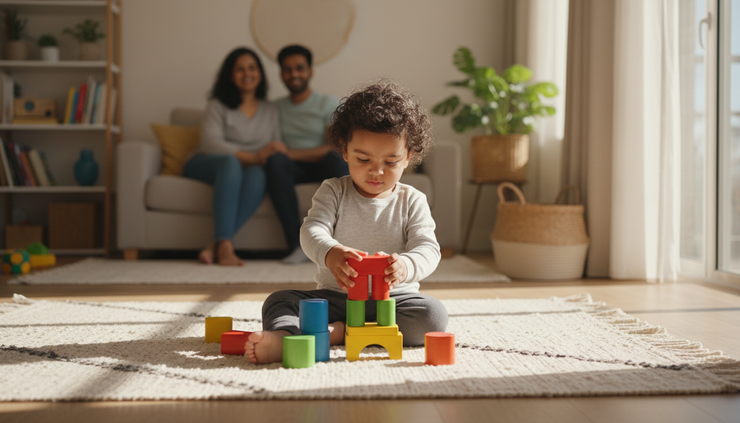
Stack several blocks
Scribble with crayons
Try to draw lines or circles
Use a spoon with less spilling
Begin to open simple containers
Help pull up pants or remove socks
Put large beads on a string with supervision
These skills prepare children for later writing, self-care, and feeding independence.
A child does not need formal worksheets at this age. In fact, play works better. Give chunky crayons, play dough, nesting cups, simple puzzles, and safe household items like spoons and bowls. Let the child pour water during bath time or transfer dal from one bowl to another using a spoon, with close supervision.

Self-help skills begin to emerge
Many children in this age group want to do things alone. They may say “me” or “mine” often. This push for independence is healthy, even when it slows down the morning routine.
Look for early self-help skills such as:
Trying to wash hands
Feeding themselves with a spoon
Drinking from an open cup with some spills
Helping put toys away
Choosing between two outfits
Pulling off shoes or socks
Showing interest in toilet training
Toilet training varies widely. Some children show readiness before 3, while others need more time. Signs of readiness include staying dry for longer, noticing when they pass urine or stool, showing interest in the toilet, and being able to follow simple instructions. Pressure or punishment can make the process harder. Calm routines work better.
Cognitive and language milestones show how thinking is growing
Cognitive development is about how children learn, remember, solve problems, and understand the world. Language is closely linked to this growth. Between ages 2 and 3, children often start to surprise adults with what they remember and say.
Language grows from single words to short conversations
By age 2, many children use single words and simple two-word phrases. As they move towards age 3, they often use longer phrases and short sentences.
Examples may include:
“More milk”
“Mummy come”
“Big dog”
“I want ball”
“Where Papa?”
“My turn”
“No bath”
By age 3, many children can name familiar objects, follow simple two-step instructions, and speak in a way that family members understand much of the time. Their pronunciation may still be unclear, especially with harder sounds. That is common.
Children at this age also begin to understand more than they can say. A toddler may follow “Bring your shoes and sit near the door” even if they cannot repeat the full sentence.
Helpful language-building habits include:
Talking during daily routines
Naming objects, feelings, and actions
Reading short books every day
Singing rhymes in any home language
Giving the child time to answer
Expanding what the child says
If the child says “car,” an adult can say, “Yes, a red car is going fast.” This gives a model without turning the moment into a test.
Home languages matter. Children can learn more than one language when they hear warm, regular conversation. Families should use the language they speak most naturally. Clear connection and rich talk are more useful than forced English exposure.
Thinking skills show up during play
Toddlers learn by doing. Their thinking becomes more flexible between ages 2 and 3. They may:
Match shapes or colours
Complete simple puzzles
Sort objects by type
Look for a hidden toy
Remember parts of a daily routine
Pretend one object is another, such as using a block as a phone
Copy household actions, such as sweeping, cooking, or caring for a doll
Pretend play is a major sign of cognitive growth. A child who pretends to make chapati, feed a teddy, or talk on a toy phone is practising memory, imagination, language, and social understanding at the same time.
Screen time is not the best teacher at this age. If screens are used, keep them limited, choose slow and age-appropriate content, and watch together. Children learn far more from back-and-forth interaction with people than from passive viewing.

Social and emotional development brings big feelings and new connections
The ages 2 to 3 are famous for tantrums, but this stage is also full of affection, humour, empathy, and social curiosity. Children are learning how to be with others while still seeing the world mostly from their own point of view.
Emotional growth can look messy
A toddler may laugh loudly, cry suddenly, and refuse help within the same few minutes. This does not mean something is wrong. The part of the brain that manages impulse control is still developing.
Common emotional milestones include:
Showing affection to familiar people
Seeking comfort when upset
Saying “no” often
Showing pride after doing something alone
Becoming upset with changes in routine
Having fears, such as fear of loud sounds or strangers
Naming simple feelings, such as happy, sad, or angry
Calming with help from a trusted adult
Tantrums often happen when children are hungry, tired, overstimulated, or unable to express what they want. During a tantrum, long explanations rarely help. Safety, calm presence, and simple words work better.
A parent might say, “You are angry. I will not let you hit. I am here.” This teaches both the limit and the feeling word.
Social play slowly becomes more interactive
At 2, many children play near other children rather than truly with them. This is called parallel play. They may sit beside another child with blocks but not share a plan. Closer to 3, they may start taking turns, copying each other, or joining simple games.
Look for social behaviours such as:
Watching other children with interest
Copying actions during play
Offering a toy, even briefly
Saying “my turn” or “give”
Joining simple group songs or actions
Showing concern if someone cries
Playing simple pretend roles, such as doctor or shopkeeper
Sharing is still difficult. A 2-year-old may understand the word “share” but not manage the feeling of giving up a toy. Short turns work better than forced sharing. Try saying, “Aarav will use the truck for two minutes, then it is your turn.” Use a timer if needed.
Simple ways to support development at home
Parents do not need expensive toys or packed schedules. Toddlers need safe spaces, warm relationships, language, movement, rest, and chances to try.
Area of development | What helps at home | Simple example |
Physical skills | Daily active play | Let the child climb cushions, kick a soft ball, or dance |
Fine motor skills | Hands-on play | Offer crayons, blocks, sorting bowls, and play dough |
Language | Back-and-forth talk | Ask simple questions and wait for a reply |
Thinking skills | Pretend and problem-solving play | Give a box, spoon, and doll for make-believe cooking |
Social skills | Guided play with others | Practise taking turns with a ball |
Emotional skills | Calm naming of feelings | Say, “You are sad because playtime ended” |
A few daily habits can make a real difference.
Read together every day. Short picture books, folk stories, and rhymes build vocabulary and attention. Let the child point, repeat words, and turn pages.
Offer choices. Two options are enough. “Blue cup or green cup?” gives control without overwhelming the child.
Keep routines predictable. Meals, naps, bath time, and bedtime feel safer when the child knows what comes next.
Let them help. Toddlers love real tasks. They can put clothes in a basket, wipe a small spill, carry a spoon, or place vegetables in a bowl.
Praise effort clearly. Say, “You tried hard to put on your shoes,” rather than only “good job.” This helps children notice what they did.
Model the behaviour you want. Children copy tone, words, and actions. Saying “please,” waiting calmly, and repairing after mistakes teaches more than lectures.

When to seek professional advice
Many differences in pace are normal, but some signs deserve attention. Early support can help children build skills with less frustration. Parents do not need to wait and worry if something feels off.
Speak with a paediatrician, developmental paediatrician, speech and language therapist, occupational therapist, or child psychologist if a child between 2 and 3:
Does not walk steadily
Loses skills they previously had
Uses very few words by age 2
Does not combine words as they move closer to age 3
Does not respond to their name often
Seems unable to understand simple instructions
Does not make eye contact or show interest in people
Does not point to show needs or interests
Does not engage in pretend play by around age 3
Has extreme difficulty chewing or swallowing
Falls very often or seems unusually stiff or floppy
Shows repetitive behaviours that interfere with play and daily life
Has hearing concerns, such as not reacting to everyday sounds
Has frequent, intense distress that makes daily routines very hard
Trusting parental concern matters. Parents see the child across many settings: home, relatives’ houses, parks, shops, and daily routines. If a concern keeps coming back, it is reasonable to ask for a developmental check.
In India, a paediatrician can guide the next step and may suggest hearing checks, speech assessment, occupational therapy, or developmental evaluation. If the child attends preschool or an early learning centre, teachers may also share useful observations.
Seeking help does not mean labelling a child. It means understanding their needs and giving the right support early.
The key takeaway for parents
The journey from 2 to 3 is full of change. Children become stronger, more curious, more expressive, and more independent. They also have big feelings, uneven skills, and many moments when they need patient guidance.
Watch for steady progress across movement, language, thinking, play, and relationships. Offer simple daily chances to move, talk, read, pretend, help, and connect. Keep expectations realistic, especially during hunger, tiredness, travel, or changes in routine.
Most of all, remember that development grows through warm, repeated interactions. A story before bed, a calm response during a tantrum, a turn-taking game with a ball, and a few extra minutes to let a child try on their own all send the same message: you are safe, capable, and learning.


Comments